
European Badgers (Meles meles) are elusive animals showing peak activity during nighttime. So, it is quite difficult to take pictures of these animals without the appropriate equipment for photography in the dark hours.
Tankfully, young badgers do not necessarly adhere to the strict time schedule of their parents. They wake up earlier in the aftrnoon and, when they are big enough, they go roaming around the family sett. This is the very moment for the enthusiast wildlife photographer to make some pictures of these attractive animals..

Since they are youngsters they are also very playful, running around and teasing their siblings.

They also show their strong claws which will help them build and extend burrows (the “setts”) when they become older. These setts can reach as deep as five metres and have multiple entrances which are kept clean all the time.
Just before nightfall the youngsters flock together again and go back into the sett to be woken up by their parents before their common nighttime excursions for food.
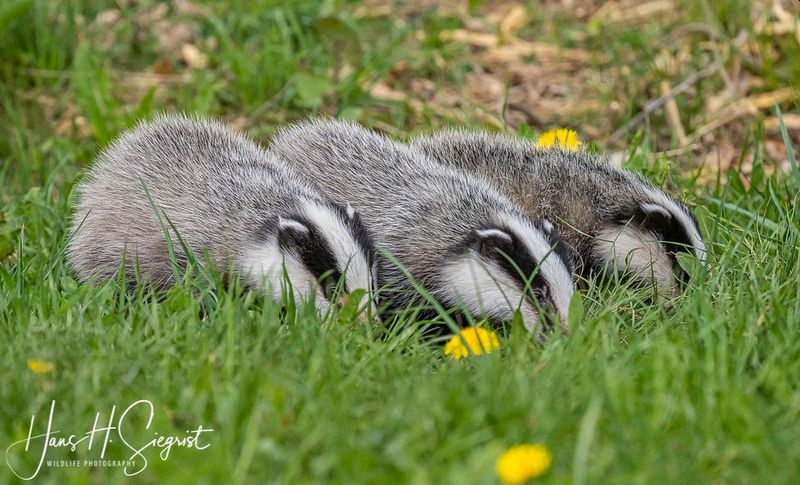
All pictures taken with the Olympus E-M1X camera and The Olympus 4.5/150-400mm + TC1.25 lens
After an unsuccessful attempt at photographing brown bears (Ursus arctos) in Slovenia about three years ago I returned to that country with three fellow photographers in September 2019. This was the third excursion aiming at bears since I had been to Finland in 2009 where I managed to take photos of this species during three nights in small hides.
This time I booked with my friends a four-day stay at https://slovenianbears.com which was founded by a young nature enthusiast, Miha Mlakar, who invests all his time in the management of the brown bears in his country, Slovenia, and has built several hides for bear watching as well a bear photography for us wildlife photographers. Slovenia harbours 500-700 bears on an area a bit more than half the size of Switzerland (22,000 sq. km). The low density of human population helps a lot as there are only 2 million inhabitants. Another important element is the presence of a huge surface of contiguous forest where the animals can lead a relatively undisturbed and quiet life.
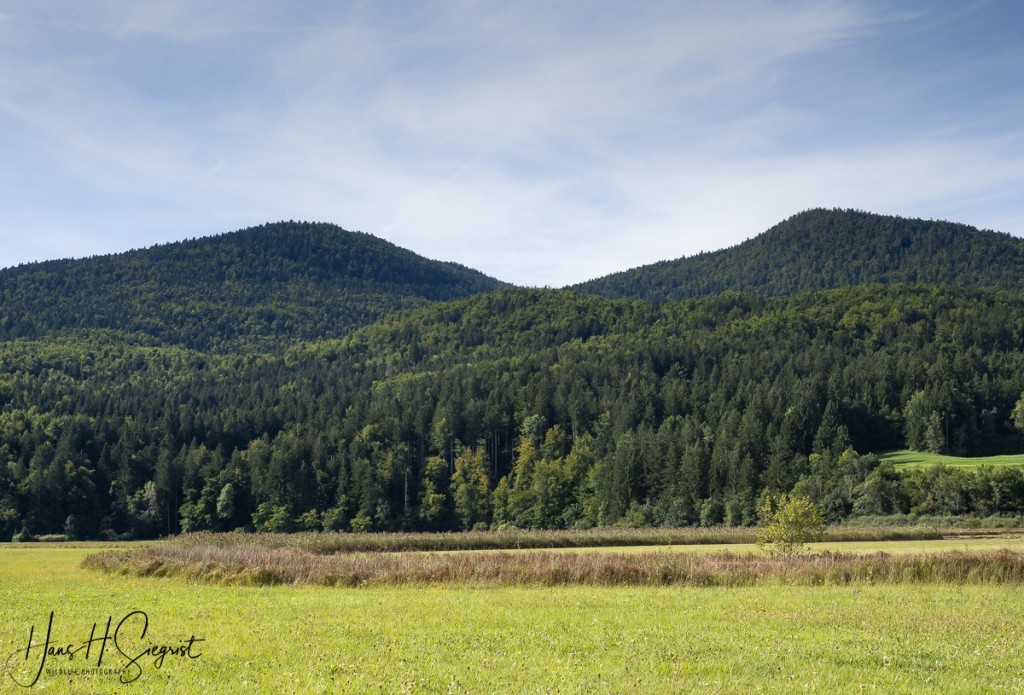
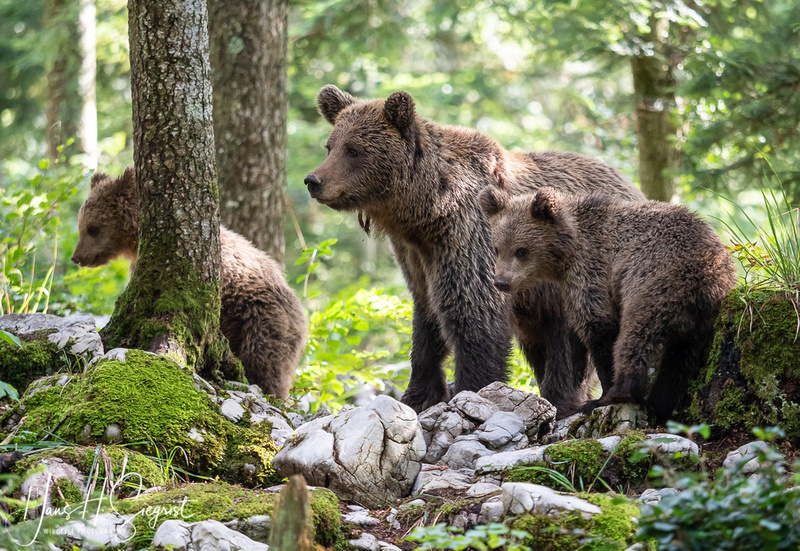
The hides are located deep in the Slovenian forests and accommodate two to four photographers with their equipment. Three to four half-days of photography should be sufficient to encounter bears coming close enough to be photographed. Of four afternoons we had three where we managed to take pictures of a total of eight different individuals including two one-year-old and three two-year-old cubs, two females and one male bear. The distance between us and the bears ranged from about 10 to 50 metres.
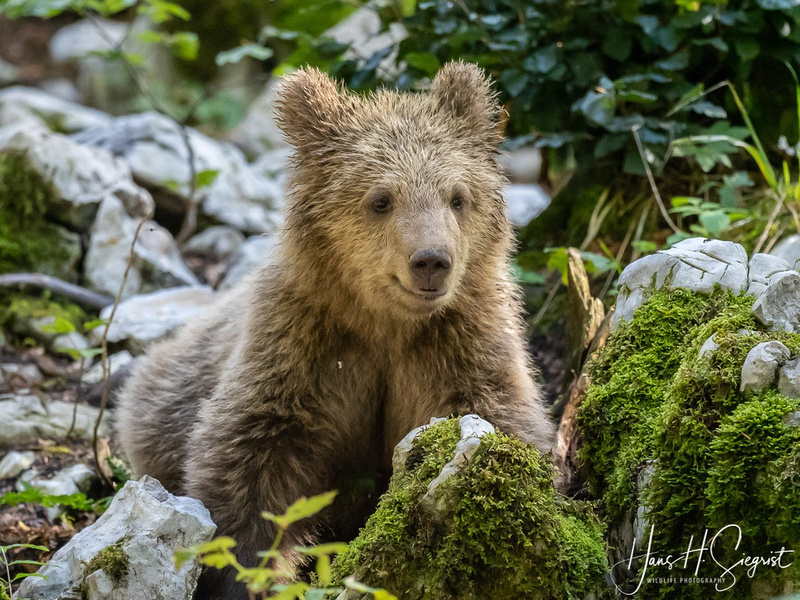
As the forests are quite dense, the light reaching the ground may be quite low, even on a sunny day. In order to avoid slow shutter speeds the ISO must be set quite high. Most of my pictures were taken between 1000 and 6400 ISO resulting in some noise which was quite easily eliminated in post-processing.
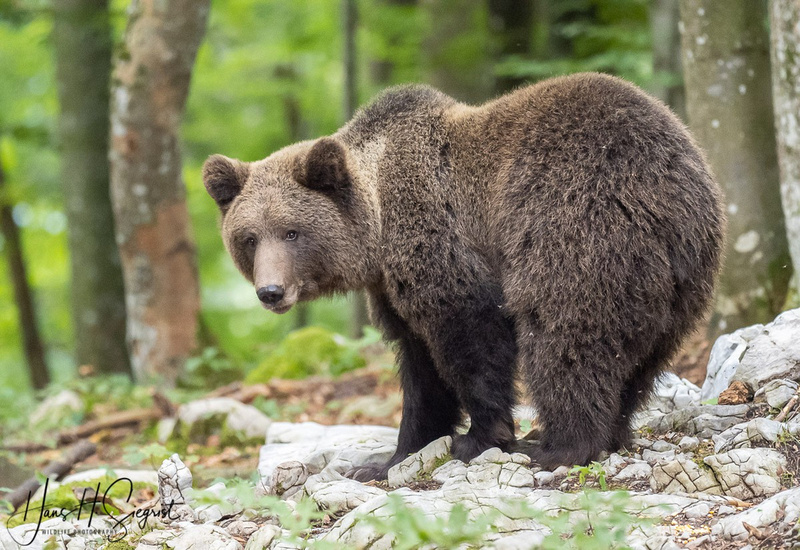
All pictures were taken with Olympus digital camera equipment (bodies: E-M1X and E-M1 MkII, lenses: 2.8/40-150mm Pro and 4/300mm Pro).
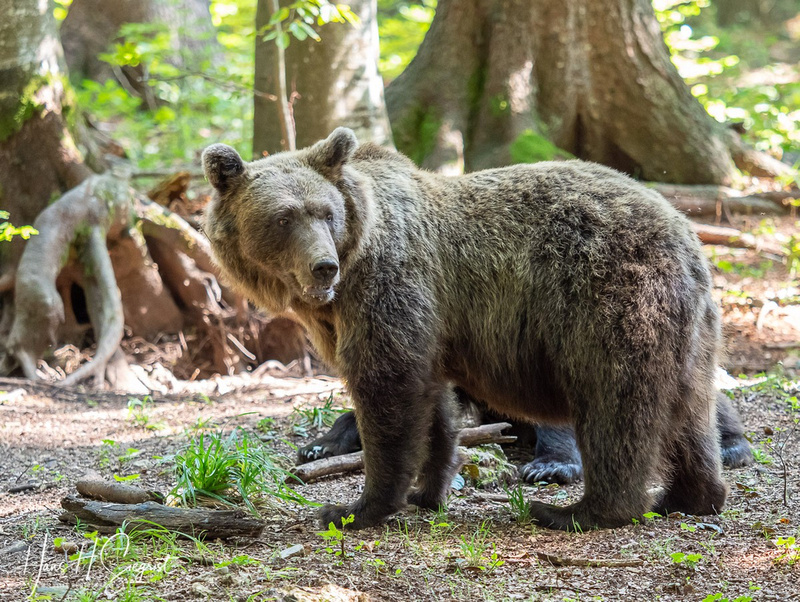
Occasionally, people ask me how I get so close to wild European bears. As I outlined above, you won’t be able to approach the bears in the open, let alone let them come to you. Bears usually avoid contact with humans and the history of our relationship with these animals confirms this behaviour as justified. The only way is to use solid hides where the human presence is difficult to detect for the bears. >
More pictures at my homepage https://hhsiegrist.zenfolio.com/p817845488
Bulgaria is a country which has still many wild spaces allowing its bird population to thrive and, at the same time, keep its high level of biodiversity. Therefore it is one of the bird photographers’ paradise in Europe. Local ornithologists and wildlife photographers are able and willing to assist their clients in order to obtain high quality photographs. Nest photography is often frowned upon if not radically rejected for obvious reasons. The intrusion of photographers is difficult to bear for the breeding couple and the risk of them abandoning their young is not to taken lightly. The Bulgarian guides carefully prepare the sites so that nest photography is rendered possible with a minimal disturbance of the breeding birds. It was by this opportunity that I managed to photograph pictures of a breeding couple of Golden Orioled as well as the nest of Red-backed Shrikes. All pictures were taken from hides which had been constructed long beforehand so that the birds got accustomed to their presence. 
 Some other hides were made available for some of the most colourful birds in Europe, Bee-Eaters and Rollers. Most of the Bee-Eaters live in Southern Europe but they gradually move north so that they can also be found in Central Europe although they are not very widespread around here for the moment. Rollers are even scarcer around here and a trip to Southern Europe is recommended.


Smaller birds include the Black-headed Bunting which is restricted to Southern Europe.  The hides we used were either solid wooden constructions or movable individual tent-style hides. Both kinds are practical and reasonably comfortable enabling the photographer to spend a few hours within. Bringing some food and, very important, drinking water is mandatory in the hot climate of Bulgaria. Pictures were taken from 7 to 11 am and from 4 to around 8 pm in order to avoid the very harsh midday light.
More pictures on my website http://hhsiegrist.zenfolio.com
Much has been written in Switzerland about our national park. This year it celebrates its 100th birthday. In 1914 a small part of the canton of Grisons (Graubünden) was selected for protection of the highest possible level. All human intervention was banned and strict rules are enforced. Visitors are not allowed to leave the footpaths. Dogs are banned. Camping and lighting fires are forbidden. Staying overnight, except at the Cluozza hut, is illegal. So what can you do, really? Carefully plan your hikes and enjoy the pristiine nature of this exceptional jewel of conservation.

The views from different altitudes, roughly between 1800 and 2800 metres above sea level, are spectacular


Be sure to bring all sorts of clothing since alpine weather conditions can change dramatically within one or two hours.
Wildlife photography, albeit possible, is not an easy task in the park. While there are lots of different species, getting them within reasonable distance for taking pictures is not easy at all. In addition, as this is not a zoo, some species may simply not be available for observations at a particular moment.
There is one exception, though. Around the rare rest areas you may see Alpine Marmots running in and out of their dens and, if you are quick enough, a good snapshot is possible

Especially now in autumn these lovely critters are very busy harvesting whatever they can get in order to accumulate fat reserves for their hibernation

As to flowers, spring is the season of choice with an immense variety of plants. The Edelweiss stays on and can also be seen towards the end of the year

Much more information can be found on the park’s website:
More pictures, as usual, on http://hhsiegrist.zenfolio.com
Horse lovers exist all over the world and photographers love to take pictures of these elegant animals that have been accompanying the human species for a few thousand years.
Of the truly wild horses only Przewalski’s Horse (Equus ferus przewalskii) remains.The last animals in the wilderness disappeared some decades ago in central Asia and only a few individuals survived in two zoos. Another example showing that animal parks are not completely useless since they occasionally allow the preservation of species while they are extinct from the environment due to human activity. See also the Europen Bison (Bison bonasus) and the Musk Ox (Ovibos moschatus). Three hundred animals have since been reintroduced in the Mongolian wilderness where they are adapting again to total freedom and its joys and dangers.
Short of travelling to Mongolia these beautiful horses can be seen in our animal parks.

Today’s modern parks try to give the animals enough space to move around and also keep their distance from humans if they choose so. Przewalski’s Horse is a poney sized small horse with a close genetic relationship to our domestic horses and can interbreed with them although this species has never been domesticated. Their behaviour is very similar to our horses’ as they prefer to live in groups rather than as single individuals.
With a little patience nice pictures are possible such as the following ones:


All pictures taken at Langenberg Wilderness Park, Zurich, Switzerland. Olympus E-M1, ZD 50-200mm, EC-14.
Larger pictures on my website: http://hhsiegrist.zenfolio.com/p505498233
A few days ago we had the first snow of this season and I thought of writing an article about the photography of winter landscapes. Meanwhile the sun has started shining again and a warm wind blows from the mountains (the “Foehn” as it is called in Switzerland) and the project seems to have lost its urgency. Well, winter can’t be far away now and I have the time to write a few lines and share my experience.
There are two main factors that make the difference between photography in warm days and the particular conditions in winter. One is the light reflected from snow and the second is the cold sapping battery power. As for the second point, try to keep the batteries warm either by keeping the camera close to your body or, better still, bring a second battery pack which will replace the cold one while you reheat the latter with your body warmth.
A frosty morning

The first problem, exposure, is based on the fact that the camera meter supposes that all reflected light falling on the camera sensor is close to 18 percent grey which results in underexposed pictures of snowy landscapes. Pictures like the one above hardly need correction but the next one

would have been totally underexposed without a +1.5 EV correction of the camera meter.
In the old film days it was all guesswork, trial and error and the final result visible only after you got back your slides and put them on the lighting table. Too late for correction then…
Nowadays digital cameras offer you the histogram feature. All you have to check is if your exposure is well balanced and at the right place on the x-axis. For snowy landscapes you would prefer to have your pile on the right hand side but avoiding burnt highlights. By the way, exposing “to the right” avoids luminance noise anyway. See also the excellent tutorial on http://www.luminous-landscape.com/tutorials/expose-right.shtml.
In hazy wintry conditions colours are almost invisible and you can end up with unintentional black and white photography

A special challenge is a beginning blizzard where the details become blurry and you come close to a whiteout


A few minutes later the whiteout was almost complete and the hike back on snowshoes turned into a minor nightmare.
One thing I forgot to mention is the photographer’s comfort, of course. Cold feet, hands and ears will put you off winter landscapes rather quickly. So make sure you have the right clothing for this purpose. Warm boots, gloves and caps are essential. Gloves should be thick enough to protect from the cold but not too thick to prevent you from using the camera dials and buttons. I use a pair of Finnish cross-country skiing gloves with rubber dots on the fingertips. In severe cold a second pair may become necessary between shootings.
Despite the difficult conditions landscape photography in winter can be quite rewarding and many a result will speak for itself.
More pictures on my homepage http://hhsiegrist.zenfolio.com/.
Autumn is the season when nature prepares for the coming winter. As the temperatures fall trees shed their leaves, mushrooms pop up and many animals either eat as much as they can to grow fat and accumulate energy for the winter or they gather seeds and nuts to hide them away for later consumption.
For the nature photographer the season of autumn is a bounty of vivid colours when the sun is out or a challenge when it rains and the winds blow. Here in Switzerland the colours begin to develop but for the time being it id rather wet and windy. No reason to stay at home and warm one’s feet at the fireplace, though. Appropriate clothing and a few precautions for the camera enable us to take pictures of rare beauty in dismal weather.


Mushrooms are one of my favourite subjects in the autumn. Bright colours are provided by the Fly Agaric:

A more mature specimen

A group of small (“anonymous”) mushrooms

Or the imposing Shaggy Ink Cap

This last one is also edible.
Autumnal forests can provide an excellent setting for fascinating nature photography even in not so optimal weather conditions. One just has to get out of the warm sitting room into the great outdoors without hesitating too much. Why not give it a try?
By the way, all pictures were taken with a highly portable compact camera in RAW format. I usually avoid making straight JPEG files as I would lose the latitude of the digital negative for post processing. This allows for a better presentation of one’s photography and a closer rendering of one’s impressions at the moment when the picture was taken.
More nature photography on http://hhsiegrist.zenfolio.com
Musk Oxen (Ovibos moschatus) are a species dating back many thousands of years that survived only in northern Canada and Greenland. In 1947 they were introduced to the Dovrefjell National Park in Norway from which some have emigrated to form small colonies in Sweden. Nowadays they can be found in Canada, Alaska, Greenland, Siberia, the Kola peninsula and in Scandinavia. The populations are thriving and their survival is safe. Dovrefjell alone harbours almost 400 individuals.

To get to Dovrefjell one has to follow the E6 road from Dombås to Kongsvoll and leave the car on the car park beside the road. The footpath starts on the other side of the road leading over a wooden bridge and below the Dombås-Trondheim railway line. It climbs through a lovely birch forest up to the vast plain of the national park. It then continues for several kilometres through a tundra landscape above the treeline and the first musk oxen will become visible.

Once in contact with the animals the photographer can start a slow approach to get pictures of these gentle animals which are, by the way, closer to goats than to bovines. Females with calves and isolated bulls can be rather aggressive, although serious accidents are rare. Proceeding carefully can result in lovely portraits of both male and female animals.

No need to take very big lenses. A medium range telezoom like a 100-400mm with a 1.4x converter will cover almost all situations where the light is bright enough..
The whole series of pictures can be found under the following link: http://hhsiegrist.zenfolio.com/p131192008
Cuban wildlife is a little bit elusive since one has to go to the right spots in order to find something. Our right spot war the Pinar del Rio Province which also grows the famous tobacco which is the basis for the Cuban cigar industry.
Cuba does not harbour dangerous wildlife. There are no large mammals and what one sees most are birds and small reptiles. The birds are colourful and most of the live on several of the Caribbean islands an even in Florida.
West Indian Woodpecker

La Sagra’s Flycatcher (they call it the Cuban Flycatcher)

The ubiquitous Turkey Vulture

There are many other bird species but unfortunately our time was very limited.
The typical reptiles of Cuba are the anoles
The Cuban Knight Anole

and the Brown Anole

That’s it for the moment as soon as I get back to the island I promise I will be more successful.
A frozen Monday morning at -11°C and with a lot of wind from Russia was not the most comfortable situation in which to wait for a long time for something to happen. After two hours most of the fellow photographers in our hide packed up and moved to a warmer environment for a hot cup of tea or coffee. The lagoon is now completely frozen and covered in snow so that even the water birds make themselves very rare.
All of a sudden the reeds started moving and before long a scavenger pointed his nose looking for dead birds or some other edible fare

The Red Fox (Vulpes vulpes) is an animal with a large habitat including forests and fields but also villages and even large cities where it is much easier to get food by scavenging rubbish dumps and dustbins. This specimen here lives in the forest close to the lake and comes out regularly to search for dead water birds or small rodents which fall victim to the severe cold that has been keeping Europe in its fierce grip for the last two weeks. Its beautiful thick winter fur protects it well against the low temperatures. On the other hand, food is not as freely available as it is closer to human presence. While red foxes in cities become almost oblivious to human presence, this one ran off immediately when it heard the shutter clicks, even from a distance of 50 metres.
The whole series of about 25 frames resulted in four usable pictures of which this one was the most attractive.
 Hans H. Siegrist's Nature Photography